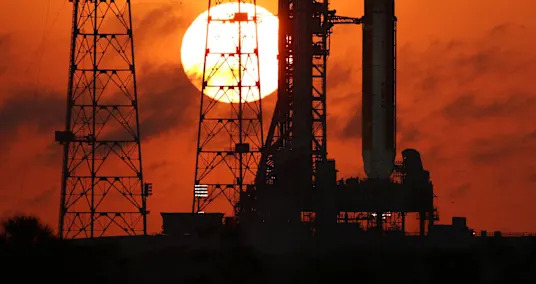
The 322-foot-tall rocket stands ready on the launch pad at the Kennedy Space Center. Fueling tests are done. The four astronauts it will send on a journey around the moon are waiting in quarantine.
NASA is making final preparations for its Artemis II mission, which could launch as early as Wednesday — a feat more than a decade and tens of billions of dollars in the making. When the astronauts finally lift off, they will be the first to launch toward the moon in more than 50 years, and they could venture farther from Earth than humanity ever has before.
But the road to this point has been long, winding and bumpy, not to mention inordinately expensive.
“This rocket was originally supposed to launch in 2016 and cost $5 billion,” said Casey Dreier, chief of space policy for The Planetary Society, a nonprofit organization that conducts research and advocacy to promote space exploration. “It costs something like $20 billion now, 10 years after that.”
Combined, NASA’s Space Launch System rocket and Orion spacecraft have cost more than $44 billion to develop. The upcoming launch will be the first time they carry people.

The Artemis program’s ever-ballooning price tag is one of several targets for its skeptics, many of whom share a “been there, done that” attitude. The years of delays are another, especially as China’s human spaceflight capabilities have rapidly advanced. Some experts and former astronauts have also voiced concerns about the Orion capsule’s heat shield, which sustained unexpected damage in the uncrewed Artemis I flight nearly four years ago and soon has to protect four crew members as they plunge through Earth’s atmosphere.
It all raises the question: Can Artemis II inject enough momentum into NASA’s return-to-the-moon program to quell its critics?
Why go back to the moon?
Unlike in the short visits of the Apollo program in the 1960s and ’70s, Artemis’ eventual goal is to facilitate long-term stays on the moon to construct a lunar outpost, conduct scientific exploration of the lunar south pole and help NASA prepare for future missions to Mars. Jared Isaacman, the agency’s administrator, said Tuesday that it plans to spend $20 billion to build that lunar base.
Some lawmakers, former NASA officials and members of the public have argued that rather than repeat accomplishments notched half a century ago, NASA should focus its human spaceflight efforts on pushing deeper into the solar system, such as to Mars.
However, Pamela Melroy, a retired NASA astronaut who was the agency’s deputy administrator from 2021 to 2025, said there is value in establishing a long-term human presence on the lunar surface and mining for valuable resources there, like water ice that could be used to make rocket fuel.
“I’ve always thought it was not a race for boots on the moon, because we won that race more than 50 years ago,” Melroy said. “It was actually going to be a race for values as we humans go out in the solar system.”
The Artemis program, she continued, is a chance to establish a new lunar economy, conduct rigorous, long-term science on the moon and locate resources that could be used for missions to Mars. As Melroy sees it, the effort is also America’s chance to establish norms for how to operate in space with transparency, in ways that could benefit all of humanity.

A more adversarial motivation for the program has also taken shape in recent years as China’s lunar ambitions have grown: The U.S. wants to win the new space race.
“The clock is running in this great‑power competition, and success or failure will be measured in months, not years,” Isaacman said Tuesday at a NASA event outlining the country’s space policy goals.
The origins of the rocket NASA is relying on to win that race, the Space Launch System, have been rooted in politics from the beginning.
Saving the space shuttle economy
As NASA prepared to retire its fleet of space shuttles in 2010 and 2011, Congress authorized creating the next-generation Space Launch System rocket as a way to soften the blow of the shuttle program’s conclusion. Senators in states like Florida, Alabama and Utah jockeyed to save jobs for longtime NASA partners and space shuttle contractors.
“It was birthed by Congress itself,” Dreier said.
In the end, the rocket was designed to use space shuttle components (the space shuttle main engines were upgraded into the Space Launch System’s RS-25 core stage engines), made in large part by the existing shuttle workforce.

“If you think about it, this is not a 15-year-old program. This is a 50-year-old program,” Dreier said. “This is the same workforce and same contractors going back to the ’70s.”
That origin story, he added, largely explains why the Space Launch System has enjoyed “rock solid” support in Congress over the years, despite its soaring price tag and even after it fell far behind schedule.
In total, developing the rocket cost NASA nearly $24 billion from its inception through the uncrewed Artemis I test flight in 2022. The Orion spacecraft, meanwhile, cost the agency more than $20 billion from when it was first developed in 2006 to 2022, according to The Planetary Society.
A 2021 audit from NASA’s Office of Inspector General projected that the entire Artemis effort would cost NASA $93 billion up to fiscal year 2025. The report estimated the price of operating the Space Launch System rocket and Orion spacecraft at $4.1 billion per launch.
Two years later, a report from the Government Accountability Office found that senior NASA officials saw the Space Launch System as unsustainable “at current cost levels.”

Some of the problems that have put the program behind schedule and over budget stemmed from how the rocket was conceived.
For instance, hydrogen leaks that forced NASA to delay the Artemis II launch earlier this year (the same issue also delayed Artemis I in 2022) hark back to NASA’s space shuttles, which were designed to be reusable, Dreier said. That meant the agency needed to use a clean-burning fuel like liquid hydrogen. Molecules of hydrogen, however, are tiny and tricky to contain, making them prone to leaking.
“The rocket was mandated to use the same components and reuse the hardware,” Dreier said. “Congress locked in this design decision made for a completely different spacecraft in a completely different era, and that’s why we face these challenges today.”
Is the Orion capsule safe?
During their 10 days in space, the Artemis II crew — NASA astronauts Reid Wiseman, Christina Koch and Victor Glover and Canadian astronaut Jeremy Hansen — will live in the 16.5-foot-wide, gumdrop-shaped Orion capsule.
After the Artemis I test flight, NASA found damage to a critical layer of thermal protection at the bottom of the spacecraft that protects astronauts from fiery hot temperatures as they re-enter Earth’s atmosphere at the end of the mission.
A NASA investigation found that part of the heat shield’s material cracked, “causing some charred material to break off in several locations.” The agency determined that gases that built up in the shield’s outer material did not vent properly, allowing pressure to accumulate.

Future heat shields will feature design changes to fix the issue —specifically, a more permeable layer of outer material — NASA officials said. But for Artemis II, the heat shield remains the same.
To avoid risk to the astronauts, mission managers’ strategy is to alter the capsule’s re-entry path. Ordinarily, before it begins its final descent, the Orion spacecraft is meant to dip briefly into the atmosphere, then pop up again — like a stone skipping on the water’s surface — to reduce heat stress and G-force on the capsule. It will not do that during this flight, however, instead descending faster and at a steeper angle to minimize the time it is exposed to the most extreme temperatures.
The new plan came after extensive testing, according to NASA, and Isaacman said in January that he had “full confidence” in the heat shield.
Wiseman gave a similar assessment: “If we stick to the new re-entry path that NASA has planned, then this heat shield will be safe to fly,” he said at a media event in July.
Two years to a moon landing
Another key criticism of the Artemis program has centered on the yearslong stretches between launches. Nearly four years have passed since the Artemis I flight, and until last month, the plan after Artemis II was to wait two more years for the next launch.
Critics have argued that the lengthy intervals made the program less safe because teams could not improve and iterate quickly, the way commercial space companies like SpaceX do.
“The fact that the Space Launch System cannot launch very frequently was a huge structural and safety risk that has been known for a long time,” Dreier said, adding, “You only have so many chances to learn about what your failure modes are.”

To address those issues, Isaacman recently revamped the Artemis program. The changes, which he announced less than three months into his tenure at NASA, include additional missions and an increase in the pace of launches.
Now, the Artemis III mission, which was originally going to land astronauts on the moon in 2028, will instead launch to low-Earth orbit in mid-2027 for technology tests and demonstrations. NASA’s complicated plan to get to the lunar surface involves a second spacecraft — a lander built by SpaceX or Blue Origin — that would dock with Orion in lunar orbit, then carry the astronauts down to the moon. Artemis III aims to practice such a maneuver. The commercial sector has also faced setbacks, though: A report this month from NASA’s Office of Inspector General said SpaceX’s Starship lander is behind schedule by “at least two years, with additional delays expected.”
Under its new plan, NASA aims to put boots on the moon with the Artemis IV mission in 2028.
As part of the changes, Isaacman said, the goal is to launch the Space Launch System rocket roughly every 10 months, rather than every three years.
That all hinges on a successful Artemis II mission, which could give NASA — and perhaps the American public — a much-needed boost.
“Whenever the White House really needs a good news story, they come to NASA,” Melroy said.
This article was originally published on NBCNews.com
LATEST POSTS
- 1
 Novo Nordisk cuts Wegovy price as CEO pledges to go 'all in' on weight loss pill
 - 2Holiday weather forecast: Where travelers can expect a wintry mix, flooding and record warmth across the U.S.
- 3Ghassan Al-Duhaini to replace Abu Shabab as Popular Forces leader in Gaza
- 4Excursion to Different Universes: the Top Sci-fi Motion pictures Ever
- 5Tracking down the Right Equilibrium: Charges versus Personal Costs in Senior Protection.


- Earth’s magnetic field protects life on Earth from radiation, but it can move, and the magnetic poles can even flip
- Finding Ideal Date Spots for Two or three Encounters
- Spanish police and soldiers track boars, reinforce farm security amid swine fever outbreak
- Instructions to Upgrade the Mechanical Highlights of Your Shrewd Bed for a Superior Night's Rest
- Mobility exercises are an important part of fitness as we age. Here are some tips
- There’s ‘super flu,’ COVID, RSV. Is it going around in SoCal?
- Uranus's small moons are dark, red, and water-poor
- Instructions to Redo Your Kona SUV for Improved Tasteful Allure and Usefulness
- 4 Creative Savvy Home Gadgets of 2024: Reforming Home Robotization and Security


