There may be continued debate in some circles as to when, if ever, quantum computing will become a viable enterprise solution, but it matters little to a growing number of providers who are already offering early commercial and pilot quantum solutions to a market exhibiting strong upward demand.
For leaders, it’s time to move beyond a wait and see approach and begin to evaluate how quantum computing can play a role in their operations.
At a minimum, dependent on the industry, some form of experimentation is certainly warranted. Breakthroughs in areas such as material simulation, optimization, early-stage quantum-enhanced machine learning, and post-quantum cryptography are beginning to offer a tease at the opportunities for competitive advantage and operational efficiencies.
A Quantum Computer Leader Is Taking Shape
As of 2026, no single economy has a monopoly yet on quantum computing technology and marketplace, but a global race to dominate and lead is clearly underway. While the US and China are moving quickly with sizable investments and progress, others including the UK, Germany, and Canada are emerging as notable players.
Notably, after steady focus and national investment for over 25 years, Australia is rising as a quantum computing star among this elite group of economies. Beyond establishing quantum research and development as a national strategy, the country has built a healthy startup ecosystem and produced a pipeline of impressive quantum physicists and engineers.
A model of Australia’s efforts is the ARC Centre for Quantum Computation and Communication Technology, a multi-university network headquartered at the University of New South Wales (UNSW) in Sydney, Australia and founded in 2011.
The organization has been primarily focused on turning quantum physics into usable computing with a particular interest in a silicon-based approach, rather than other methods that include photonics and trapped ions.
In 2017, after a series of technical breakthroughs and with $82.4M in seed funding, the center spun off an entity, Silicon Quantum Computing (SQC), to commercialize their research in real, enterprise-ready solutions.
Australia’s Quantum Bet Begins To Pay Off
At the helm of both the ARC Centre and SQC is Professor Michelle Simmons, who was named in 2018 as Australian of the Year, one of the nation’s pre-eminent awards. Her technical background and accomplishments are notable. She is a pioneer in building electronic devices at the atomic scale, including the world's smallest transistor and the first two qubit gate using atom-based qubits in silicon.

Professor Michelle Simmons, CEO & Founder of Silicon Quantum Computing and Director of ARC Centre of Excellence for Quantum Computation and Communication Technology
Silicon Quantum ComputingWhile continuing her work as a professor and researcher, she now finds herself as the CEO and founder of a fast-growing quantum computing provider.
As a result of her primary research focus and that of the ARC Centre, SQC’s solutions are based on qubits—the basic units of quantum information—derived from silicon atoms. Simmons believes that many of the technical outcomes of this silicon-based approach, such as coherence, are superior to other options such as neutral atoms, superconducting metals, and photons.
According to Simmons, SQC is moving faster than other quantum providers because they decided from the beginning to become a quantum processor unit (QPU) manufacturer rather than outsourcing the creation of their hardware requirements. If they went the third-party route, turnaround time to build their semiconductors could be as long as 40 weeks. Doing it themselves can be as quick as one week.
Owning the manufacturing process has meant that SQC can meet their high-precision and accuracy needs and move extremely fast. In fact, they are able to consistently beat their own delivery targets. They had targeted 2028 for their first commercial product but were ready and shipping in 2025.
The Race To Fault-Tolerant Quantum Computing
Simmons’ big vision is to build a fully error-corrected quantum computer. This is a system that uses imperfect qubits to create stable logical qubits that can process long, reliable computations. It’s not a trivial goal. Today, the difficulty in managing errors is a central problem that continues to hamper quantum computing progress.
As progress is made, better error correction increases the number of reliable logical qubits that can be deployed resulting in faster computation. Canada’s D-Wave has deployed around 5,000 qubits using a quantum annealing approach optimized for specific problems, while IBM’s 1121-qubit Condor processor represents a general-purpose gate-based system.
SQC has identified 2033 as the year they will support a million qubits. If they hit that target, the computational capabilities will be staggering and enable quantum computing to deliver enterprise solutions from materials discovery to large-scale industrial optimization. Simmons doesn’t believe it’s a pipe dream; moreover, their current rate of iteration suggests it’s achievable.

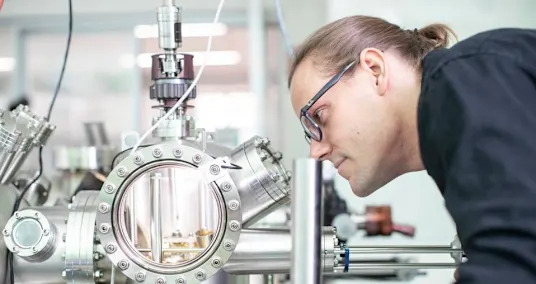
Engineers work on a quantum computer at the Silicon Quantum Computing facility
Silicon Quantum ComputingToday, SQC delivers a commercially available QPU called Watermelon. It uses quantum reservoir computing, a Japanese innovation, that can be considered a shortcut to useful quantum machine learning.
As a related example, instead of just increasing the number of GPUs to accelerate AI training, certain processing can be offloaded to a QPU which may offer speed and efficiency advantages. For one recent telecommunications client, Watermelon was able to reduce the time to process a specific AI training set from several weeks to a few days.
From Digital Twins To Quantum Twins
SQC’s next product, which is currently being tested with a small set of potential customers, is their quantum twins. Simmons says their work is inspired by Richard Feynman’s lecture from 1959 where he said you can’t understand the world unless you can build it at the same scale.
Quantum twins address a core limitation: classical systems struggle to simulate complex quantum interactions as system size grows, particularly for complex molecular systems. Such a limitation doesn’t exist using quantum computing which can simulate complex structures at the atomic scale. A quantum twin will enable the exploration of the fundamental states of matter and help answer questions about a wide range of unknowns in the world of physics and chemistry.
A promising area for quantum twins is in drug discovery. While progress has been made in simulations, pharmaceuticals still rely heavily on a trial-and-error process. A new drug must be tested and results measured and this not only takes a long time, but how the molecules behave and interact between each other and the human body and are often not well understood. Using a quantum twin, researchers can model, simulate, observe, and measure the precise behavior that may occur as molecules interact. It has the potential to transform the world of medicine.
A Quantum Computing Roadmap
Simmons and her team are learning quickly what is required to commercialize quantum computing products. They have found that allowing potential buyers to experience and apply their solutions is the best educator. It helps the customer understand what’s possible and provides SQC with real-time feedback to evolve their solutions.
They also discovered that teaching potential customers the ins and outs of quantum computing can be a showstopper. They’re learning quickly that better acceptance occurs when complexity is hidden behind the scenes and the user is provided with a simpler, more intuitive interface. It’s predictive of a future where many will be using quantum computing capabilities without actually realizing it.
Simmons shares that a motto they have at SQC is keep it real. They avoid hyperbole and focus on delivering actual, real-world uses. It’s working as interest from customers for their Watermelon QPU and cloud service is high. To meet the demand, they’re currently building a new, expanded manufacturing facility and hiring a lot of new staff.
Simmons and SQC are delivering today what many thought was still years away, if at all possible. It may be the clearest evidence for leaders to begin ramping up their quantum computing efforts.
LATEST POSTS
- 1
 Step by step instructions to Get a good deal on Your Rooftop Substitution Venture
 - 2Daily Briefing: A bad flu season gets worse
- 3Investigate Business Mastercard Choices for Better Rewards and Rewards
- 4How 2025 became the year of comet: The rise of interstellar 3I/ATLAS, an icy Lemmon and a cosmic SWAN
- 5Instructions to Expand Your Smash 1500's Presentation: Tips and Deceives


- Easter Island quarry reveals how Polynesians made enigmatic stone statues
- The Best Computer games for Multiplayer Fun
- Abbott issues US device correction for some glucose monitors over faulty readings risk
- Vote in favor of your Favored sort of footwear
- Jupiter and the moon take a sunset stroll on March 26. Here's how to see it
- Italy's Beloved Trevi Fountain Hides A Unique Secret That Can Be Explored Underground
- The most effective method to Make a Dazzling Site in 5 Basic Advances
- Osteoporosis, the silent disease, can shorten your life − here’s how to prevent fractures and keep bones healthy
- Pick Your Favored method of transportation