A planned gas-fired power plant at a Google data center in Texas would generate up to 4.5 million tons of carbon dioxide annually, more than the city of San Francisco.
Google’s plan for a partnership with a natural gas power plant that could provide energy for one of its data centers in Texas was unearthed by new research and confirmed by the company. The move is part of an ongoing about-face for the tech giant, which once pledged to be carbon neutral by 2030 and has long been seen as a pioneer in clean energy.
The gas power plant is slated to be built in Armstrong County, a sparsely populated area in the Texas panhandle. According to a report by the research organization Cleanview, the project is being led by Crusoe Energy, which partnered with Google to develop the data center campus known as “Goodnight,” named after a nearby town.
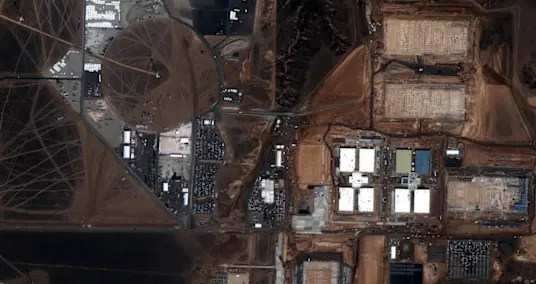
Crusoe filed for a permit in January to build the 933-megawatt power plant on the site of the Goodnight campus, which showed the facility would operate off the grid and provide energy to at least two buildings on the campus, according to Cleanview. Satellite images commissioned by Cleanview confirm construction is well under way.
According to Crusoe’s 465-page permit application, the power plant would emit as much as 4.5 million tons of carbon dioxide, a primary driver of the climate crisis, per year. For comparison, the entire city of San Francisco emits about 4 million tons of emissions annually.
Michael Thomas, the founder of Cleanview and author of the report, said that this power plant would be one of the first direct investments in fossil fuel infrastructure that he’s seen with Google.
“Google has spent decades crafting an image as a clean energy leader,” said Thomas. “I’ve always considered them to be the most committed to their climate goals. But these projects suggest a major strategic pivot at the company could be under way.”
When the Guardian asked Google about its partnership with Crusoe for the gas power plant, Chrissy Moy, a company spokesperson, did not deny the project but said: “We don’t have a contract in place for the plant in Texas.” How much electricity Google might purchase from the plant is not clear, as negotiations appear to be ongoing. She pointed the Guardian to a separate partnership the tech company has in the region for a windfarm project with the utility provider Serena Energy. Crusoe did not return a request for comment.
The power plant in Texas is the third known gas facility that Google has become involved in over the past few months. In October, the company announced an agreement to buy power from a gas plant in Illinois, and last month Flatwater Free Press obtained documents showing that Google is exploring another huge gas project in Nebraska.
Google says its focus is still carbon-free energy and that it does not see using natural gas as a departure from its climate goals. The company has stated that it is moving from a strategy of buying carbon credits to one of building the grid.
Asked by Axios last week at an energy conference in Houston about how natural gas jives with the company’s clean energy goals and overall strategy, Google’s head of advanced energy, Michael Terrell, said: “We don’t have anything to say on that.”
Google has long been a climate leader in the tech sector. In 2020, it set an ambitious net-zero emissions goal to use carbon-free energy across all operations by 2030. It has invested in wind, solar, geothermal, and nuclear energy projects. But as Google has focused more on A.I. and its high-energy needs, the company’s emissions commitments have softened.
In 2023, Google wrote in its sustainability report that it was no longer “maintaining operational carbon neutrality” but was still pushing for net zero emissions by 2030. In 2024, the company reported a 48 percent rise in greenhouse gas emissions since 2019, due to data center energy consumption.
By 2025, Google had stopped speaking in terms of concrete 2030 goals and instead framed its emissions ambitions as “climate moonshots.” “Moonshots” is a term Google uses to denote speculative projects that may or may not come to fruition, like self-driving cars, which have become widespread, and Wi-Fi balloons, which have not.
“While we remain committed to our climate moonshots, it’s become clear that achieving them is now more complex and challenging across every level,” Google wrote in its 2025 environmental report, which describes the company’s climate goals as “ambition-based” and notes that A.I.’s rapid growth is driving “significant uncertainties” around emissions.
Meta, Amazon, and Microsoft, which have also long pledged net-zero carbon goals, are turning to natural gas to power their A.I. data centers too. Meta is building an enormous facility in Louisiana that is slated to run on natural gas, and Amazon has several multi-gigawatt data centers powered by gas. Microsoft just announced a new gas project for a data center in West Virginia and signed a deal with Chevron this week to build a 2.5-gigawatt gas power plant in west Texas.
For years, “these hyperscalers have remained committed to their climate goals and have resisted the siren call of natural gas,” said Thomas of Cleanview. “But what has happened in the last few months is that the story has become more complicated… There’s this tension with the race to build A.I.”
—Dara Kerr, The Guardian
ALSO ON YALE E360
How Batteries, Not Natural Gas, Can Power the Data Center Boom
LATEST POSTS
- 1
 Pilot captures jaw-dropping northern lights show from 36,000 feet (photos)
 - 2Bennu asteroid samples provide clues about solar system origins and 'space gum'
- 3When will the Epstein files be released — and will they reveal anything new?
- 4Lightning on Jupiter could be up to 1 million times stronger than on Earth
- 5US FDA declines to approve Corcept's drug for rare hormonal disorder




- New law puts familiar drinks, creams and gummies in legal limbo
- Doctored NXT Summit footage falsely portrays Modi as declaring war on Iran and Pakistan
- What's the Fate of 5G Innovation?
- Hundreds of kilos of protected plant seized by Israel Nature and Parks Authority in Golan
- Find the Wonders of the Silk Street: Following the Antiquated Shipping lanes
- Incredible Travel Objections for Craftsmanship Darlings to Visit
- Step by step instructions to Guarantee the Strength and Life span of Your Pre-assembled Home
- Pfizer says patient dies after receiving hemophilia drug in trial
- International issues on the agenda as Frances's Macron visits China